
Hill was on the ground helping small businesses after the bushfires that devastated Victoria in early 2026. He says one of the worst aftershocks for affected businesses was how much it costs to rebuild.
“I was surprised to see the quotes and how widespread the underinsurance problem is. We’re seeing it more and more, and that’s why we’re working with brokers to make sure they’re having those conversations with their clients. Knowledge is power,” Hill says.
Underinsurance could turn a temporary physical crisis into business ruin.
“Addressing this involves being very clear about what it costs to reinstate the insured building so that the business can begin operating again quickly. It is important to consider the cost of reconstruction, the cost of removing debris and the cost of building approvals,” Hill advises.
A surprising finding from the report is the lack of formal business continuity planning by smaller companies.
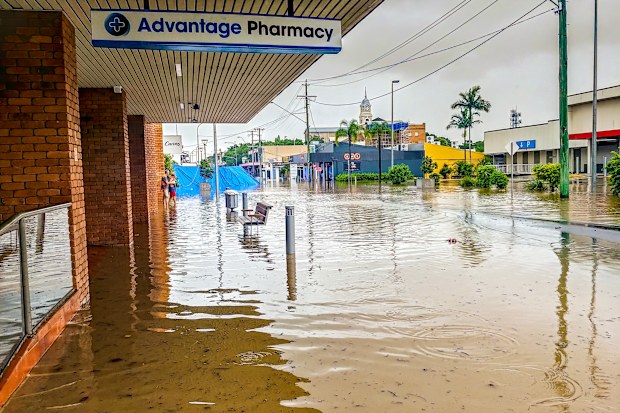
As Mary River floodwaters inundate Queensland’s Maryborough CBD, underinsurance threatens to transform a temporary physical crisis into a lasting business ruin.
“Most owners know what they would need to do to restore their business, but it’s often unwritten. That may be fine when you’re operating normally. But when the worst happens and your access to data is interrupted and you lose your contacts, a well-thought-out, written plan will serve you well,” says Hill.
The plan should include steps to get the business back up and running in the first 24 to 72 hours and then during the first week after a major event.
“For small businesses, climate risk is fundamentally an operational risk. The most serious threats come from increasingly frequent extreme weather events that disrupt key operations and supply chains,” said Nicholas Guest, partner at accounting and advisory firm HLB Mann Judd.
“Without preparation, these impacts could be existential. Most small businesses simply do not have the capacity to absorb significant revenue or cost impacts, and few have continuity plans or backup agreements with suppliers. My advice is to map your key dependencies, diversify your supply chain, and build a simple continuity plan. These are not expensive tasks, but they are essential.”
Disaster management is one of several serious issues that small businesses will face in 2026. IAG research shows that more than half (53 percent) of small and medium-sized businesses say they are facing economic and cost pressures.
“We are continually talking to our broker partners about rising construction costs, which have risen alongside global tensions. Small businesses need to be able to re-establish their businesses with correct sums insured. We encourage them to speak to a broker about how to ensure their valuations are up to date and keep pace with inflation,” adds Hill.
Accepting the risks to which the company’s location is exposed is essential for long-term business survival.
“It’s really important for small businesses to understand the potential climate exposures they face and what they can do to minimize the impact that extreme weather can have on them. They often can’t move their business, but they can understand and minimize the risk. That comes back to business continuity planning. An individual business can’t change the climate, but they can be prepared for it,” Hill says.
Ultimately, the future of the country’s small business sector depends on turning positive outlooks into practical resilience. By mapping dependencies, addressing underinsurance risk, and formalizing emergency strategies, business leaders are better equipped to safeguard their hard-earned growth against the elements.
These findings form part of the first IAG Resilient Futures Report, which introduces the IAG Risk Index, a new national benchmark index that tracks Australians’ confidence, outlook and exposure to disruption. It is based on insights from more than 2,400 consumers and small businesses in metropolitan, regional and rural communities. The research provides a comprehensive view of how Australians experience, interpret and respond to risk in an increasingly uncertain environment. View a copy of the report at iag.com.au/resilientfutures